Composite setting - Reference response reduction
A simple analytical curve fitting problem is included to demonstrate how to use piglot with a modified reference response.
In this case, we aim to demonstrate how the composite Bayesian optimisation is sensitive to the number of sampling points in the reference response, and present a strategy to mitigate this effect.
Like in the sample curve fitting example, we are trying to fit the function \(f(x) = a x^2\) using a numerically generated reference response from the expression \(f(x) = 2 x^2\) (provided in the examples/reference_reduction_composite/reference_curve.txt file).
For this example, and in contrast with the sample curve fitting example, we consider a reference response with 100 sampling points. As you will see, the computational cost of the composite Bayesian optimisation is quite dependent on this number.
Original reference response
The configuration file (examples/reference_reduction_composite/config.yaml) for this example is:
iters: 10

optimiser: botorch

parameters:
  a: [1, 0, 4]

objective:
  name: fitting
  composite: True
  solver:
    name: curve
    cases:
      'case_1':
        expression: <a> * x ** 2
        parametric: x
        bounds: [-5, 5]
        points: 100
  references:
    'reference_curve.txt':
      prediction: ['case_1']
To run this example, open a terminal inside the piglot repository, enter the examples/reference_reduction_composite directory and run piglot with the given configuration file
cd examples/reference_reduction_composite
piglot config.yaml
You should see an output similar to
BoTorch: 100%|█████████████████████████████| 10/10 [00:25<00:00,  2.52s/it, Loss: 6.1178e-08]
Completed 10 iterations in 25s
Best loss:  6.11782174e-08
Best parameters
- a:     1.999625
As you can see, piglot correctly identifies the a parameter close to the expected value of 2 but takes approximately 25s to complete the optimisation. Moreover, memory usage has a peak value of 1.17GB.
Now, we will apply a reference reduction algorithm to reduce the number of points in the reference response and see how it affects the computational cost of the composite strategy.
Reduced reference response
To perform the filtering of the data, the two-stage algorithm proposed in Cardoso Coelho et al. (2024) is used. This algorithm includes two stages which are briefly described as follows:
Elimination stage: At every iteration, eliminate a single point from the reference response. For every point in the filtered response, we simulate its removal and compute the error between the original response and the filtered response. Then, the point that leads to the smallest error is eliminated. The procedure is repeated until we reach a predefined error threshold, or we run out of inner points to eliminate.
Refinement stage: Optimise the coordinates of the resulting points to minimise the interpolated error. The optimisation variables are the time coordinates of the inner points, which are free to move along the reference time grid. The default bounded optimisation method in
scipy.optimize.minimizeis used for this task. This step retains the same number of points given from the previous stage, but it may lead to a better distribution of the points along the reference time grid.
This feature can be activated by simply setting the filtering tolerance of the reference response to a given threshold. In this case we set filter_tol: 1e-2 so that the number of points in the sample curve fitting example is recovered, that is, 6 sampling points.
The configuration file (examples/reference_reduction_composite/config_reduction.yaml) for this example is:
iters: 10

optimiser: botorch

parameters:
  a: [1, 0, 4]

objective:
  name: fitting
  composite: True
  solver:
    name: curve
    cases:
      'case_1':
        expression: <a> * x ** 2
        parametric: x
        bounds: [-5, 5]
        points: 100
  references:
    'reference_curve.txt':
      prediction: ['case_1']
      filter_tol: 1e-2
      show: False
To run this example, open a terminal inside the piglot repository, enter the examples/reference_reduction_composite directory and run piglot with the given configuration file
cd examples/reference_reduction_composite
piglot config_reduction.yaml
You should see an output similar to
Filtering reference reference_curve.txt ... done (from 100 to 6 points, error = 4.28e-03)
BoTorch: 100%|█████████████████████████████| 10/10 [00:01<00:00,  7.90it/s, Loss: 6.6555e-09]
Completed 10 iterations in 1s
Best loss:  6.65547123e-09
Best parameters
- a:     1.999832
As you can see, the information of the filtering output is provided, namely the number of points in the original and reduced responses and the expected error between the two responses. The reduced reference response after filtering is saved in a filtered_references/reference_curve.txt file inside the output directory.
Moreover, it is observed that piglot still correctly identifies the a parameter close to the expected value of 2, but now it takes approximately 1s to perform the optimisation, with a peak memory usage value of 0.53GB.
In comparison with the previous example, the computational time is now 25 times faster, and the peak of the memory is more than 2 times smaller. Note that this effect becomes even more prominent if more iterations are considered.
The reduced reference response can also be seen before the optimisation procedure by setting show: True:
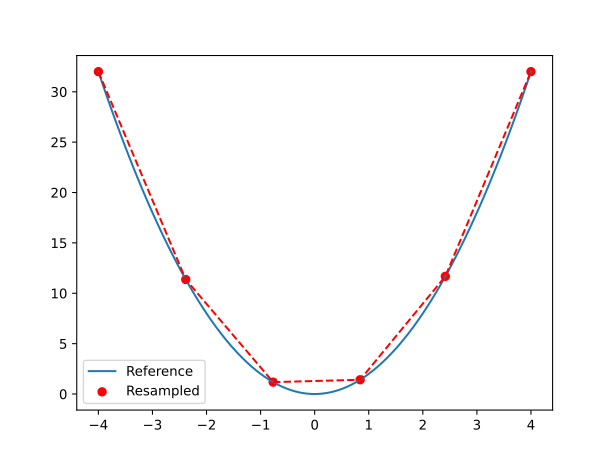
The differences between the original and reduced responses is compiled in the table:
original response |
reduced response |
|
|---|---|---|
number of points |
100 |
6 |
computational time / s |
25 |
1 |
memory peak / GB |
1.17 |
0.53 |
optimal parameter |
1.999625 |
1.999832 |
As described in examples/input_data_file_template.yaml more modifications of the reference response are readily available.